El INECOL ha publicado la convocatoria para ocupar UNA plaza de investigacion en la Red de Biodiversidad y Sistemática, en el Centro Regional del Bajío en Pátzcuaro, Michoacán.
Se espera que la persona elegida para ocupar la plaza disponible, en la medida de lo
posible, retome el liderazgo académico del Dr. Rzedowski y contribuya decididamente a
la continua publicación de la Flora del Bajío y de Regiones Adyacentes. El candidato
elegido se incorporará a un grupo de trabajo conformado por cinco investigadores y cinco
técnicos académicos involucrados en dicho proyecto. El aspirante deberá contar con
amplios conocimientos sobre la taxonomía vegetal, diversidad y morfología de plantas
vasculares, además de tener experiencia en su colecta y determinación. Es deseable tener
experiencia en las técnicas de laboratorio necesarias para la recopilación de datos
moleculares, así como su análisis y el uso de metodologías filogenéticas, aunque no
contar con la misma no cancela la candidatura. Para garantizar la continua publicación de
la Flora del Bajío y de Regiones Adyacentes y de la Revista Acta Botanica Mexicana, se
dará preferencia a los candidatos con experiencia comprobada en el trabajo editorial.
La convocatoria esta anunciada en el sitio web del INECOL
Los detalles de la convocatoria estan en:
http://www1.inecol.edu.mx/inecol/documentos/convocatorias/PlazasCRB(abril2012)FINAL.pdf
15 de agosto de 2012

26 de julio de 2012
Curso de Analisis Filogenetico
Estimados colegas,
Estoy pensando en ofrecer un curso teorico-practico para docentes, investigadores y estudiantes acerca de Analisis Filogeneticos basado en el Libro "The Phylogenetic Handbook: A Practical Approach to Phylogenetic Analysis and Hypothesis Testing" de Lemey, Salemi, Vandamme, y me gustaria primero darme una idea de cuanta gente podria estar interesada, esto con el fin de determinar si es factible llevarlo a cabo.
Por sus comentarios y sugerencias, muchas gracias!
Jose F. Garcia-Mazcorro
Estoy pensando en ofrecer un curso teorico-practico para docentes, investigadores y estudiantes acerca de Analisis Filogeneticos basado en el Libro "The Phylogenetic Handbook: A Practical Approach to Phylogenetic Analysis and Hypothesis Testing" de Lemey, Salemi, Vandamme, y me gustaria primero darme una idea de cuanta gente podria estar interesada, esto con el fin de determinar si es factible llevarlo a cabo.
Por sus comentarios y sugerencias, muchas gracias!
Jose F. Garcia-Mazcorro
23 de julio de 2012
Will DNA Barcoding wreck the NCBI Genbank?
This recent paper (An update on DNA barcoding: low species coverage and numerous unidentified sequences; published in Cladistics) on an update of the Global DNA barcoding effort should be a real eye-opener to all people who love the NCBI Genbank and the process and openness of science, and especially to taxonomists.
....
So the paper published in cladistics, looks at the claims of these “barcoders” and find some problems. They check whether:
- This project lived up to its initial speech act? (species coverage problem)
- Is it progressing scientifically? (“taxonomy” wise is it 100% percent right?)
Well, the answers are in the negative.They find ~60,000 “metazoa” species’ barcodes in the NCBI database, which is well below the number of 10-20 million total species on earth (some claims are less but see the link). This is despite having substantial funding from the governments for the barcoding initiative. This paper says that they (Barcoding consortium) received $80 million from the Canadian government, we know about many other sources where every small barcoder gets tens of millions.....In short, DNA barcoding has performed below par, and their quest to barcode all species has failed at least until now. The main problems could be that they did not have trained taxonomists in their ranks. They are against taxonomy using morphological identification, thus these taxonomists distance themselves from barcoding, and barcoders know little taxonomy to correctly identify a species to its specific level. If barcoders say that they found cryptic diversity that was deposited as “sp.” in databases, then why 1000 specimens (with <1% identity), and I would also ask those people to read better about species delimitation methods.
....
LEER MAS AQUI>
16 de julio de 2012
DNA barcoding: mucho ruido ... pocas nueces .... muy ... muy caras!
Cladistics Early on line: An update on DNA barcoding: low species coverage and numerous unidentified sequences
Abstract
DNA barcoding was proposed in 2003, the Consortium for the Barcode of Life was established in 2004, and the movement has since attracted more than $80 million funding. Here we investigate how many species of multicellular animals have been barcoded. We compare the numbers in a public database (GenBank as of January 2012) with those in the Barcode of Life Database (BOLD) and find that GenBank contains COI (cytochrome c oxidase subunit 1) sequences for ca. 60 000 species while BOLD reports barcodes for ca. 150 000 species. The discrepancy is likely due to a large amount of unpublished data in BOLD. Overall, the species coverage remains sparse, growth rates are low, and the barcode accumulation curve for Metazoa is linear with only 4788 species having been added in 2011. In addition, the vast majority of species in the public database (73%) were barcoded by projects that are unlikely to be related to the DNA barcoding movement. Particularly surprising was the large number of DNA barcodes in GenBank that were not identified to species (Jan 2012: 74%), with insect barcodes often being identified only to order. Of these several hundred thousand have since been suppressed by NCBI because they did not satisfy the iBOL/GenBank early release agreement. Species coverage is considerably better for target taxa of DNA barcoding campaigns (e.g. birds, fishes, Lepidoptera), although it also falls short of published campaign targets.
© The Willi Hennig Society 2012
5 de julio de 2012
Tema de la semana > Homoplasia: De bestia negra a caso valioso.
Tema de la semana >
Homoplasia: De bestia negra a caso valioso
publicado a la(s) 12/10/2011 06:36 por Martín RamírezTradicionalmente concebida como un problema para la sistemática, la homoplasia nos ofrece una oportunidad única de estudiar fenómenos históricos que de otra manera sería únicos. Wake et al. (2011) presentan una revisión didáctica de la utilidad del estudio de convergencias y reversiones para comprender los mecanismos subyacentes a la evolución de la morfología.
Wake, D.B., Wake, M.H., Specht, C.D., 2011. Homoplasy: from detecting pattern to determining process and mechanism of evolution. Science 331, 1032-1035. [PDF]
24 de junio de 2012
Inicia la reunión de la Willi Hennig Soc en Riverside, CA
Como si estuviera en casa. Español por todos lados. El sábado por la tarde fue el registro y la recepción, con un buen representativo latinoamericano, bueno sobre todo argentinos. Hoy Domingo inicia el programa de presentaciones y se extenderá hasta el Miércoles.
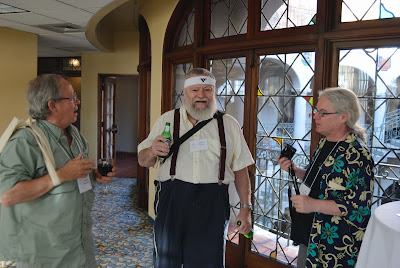
Stevenson, Farris y Carpenter durante la recepción de bienvenida. (foto de GY Zhang)

Quentin Wheeler, en la conferencia plenaria inaugural. (foto de GY Zhang)
Los premios a estudiantes:
John Denton fue distinguido con el premio Willi Hennig para la mejor presentacion por estudiantes.
Guayang Zhang ganó el premio Don Rosen para el mejor cartel.
Cecilia Waichert recibió el premio Lars Brundin para la mejor segunda presentación oral.
Quieren ver más fotos? GY Zhang, del equipo organizador local estarár subiendo fotos a Picasa: https://picasaweb.google.com/112984361567457674060/Hennnig2012Riverside
Saludos desde Riverside!
Stevenson, Farris y Carpenter durante la recepción de bienvenida. (foto de GY Zhang)
Quentin Wheeler, en la conferencia plenaria inaugural. (foto de GY Zhang)
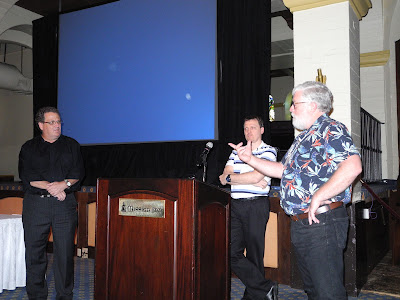
Wheeler, Meier y Mishler durante el simposio sobre el concepto de especie. (foto de GY Zhang)
Los premios a estudiantes:
John Denton fue distinguido con el premio Willi Hennig para la mejor presentacion por estudiantes.
Guayang Zhang ganó el premio Don Rosen para el mejor cartel.
Cecilia Waichert recibió el premio Lars Brundin para la mejor segunda presentación oral.
Quieren ver más fotos? GY Zhang, del equipo organizador local estarár subiendo fotos a Picasa: https://picasaweb.google.com/112984361567457674060/Hennnig2012Riverside
Saludos desde Riverside!
5 de junio de 2012
Salvador Arias ha ganado el premio GBIF
Salvador Arias ha ganado el premio GBIF - jóvenes investigadores- por el desarrollo del programa para estudios biogeográficos VIP (Vicariance Inference Program).
Salvador esta actualmente trabajando en el INSUE-Tucumán, haciendo su Doctorado bajo la dirección de Pablo Goloboff y Claudia Szumik.
Acá mando el Link de la noticia:
http://www.gbif.org/communications/news-and-events/showsingle/article/awards-tar\
get-novel-research-on-species-distributions
y aquí el del programa:
www.zmuc.dk/public/phylogeny/VIP/intro.htm
Un groso! Felicitaciones Salva!
Santiago Catalano

23 de mayo de 2012
Hennig XXXI Workshop: Scripting with TNT, Riverside, CA

Participantes del taller de scripts con TNT

Durante las sesiones del taller

Pablo Goloboff y participantes
There has been enough interest expressed for a post-meeting workshop: Scripting in TNT.
The exact location of that, and where you might book accommodations has not been determined yet.
The workshop will run on the 28th, 29th and 30th, June, 2012
Pablo Goloboff (one of the co-authors of the program) and Mark Siddall (who has experience writing scripts) are offering to give a short, 3-day course on scripting for TNT, in connection with the next meeting of the Willi Hennig Society in Riverside, California (June 23-27, 2012). TNT is a program for phylogenetic analysis under parsimony. Even David Swofford praises it as a good phylogeny program, and it is widely recognized as one of the most powerful programs for phylogenetic analysis. Casual users find it very difficult, because it presents so many options that it is difficult to begin using it. Thus, the program left Matthew Vavrek totally confused, and The Manual caused irreparable damage to the eyes of poor Paulo Nuin (see the Blind Scientist blog). The powerful scripting language of TNT makes it possible to use the program for an enormous variety of calculations and tests, with a flexibility far beyond any other single program for phylogenetic analysis. See the script for consistency and retention indices as an example of a very simple script, Siddall's script for partition bootstrapping as something easily accomplished with slightly more knowledge and then as well Pol and Escapa's script for iterative PCR or Goloboff's script for testing delayed character correlation as examples of more complex scripts. This course (see the syllabus below) would be directed to those people who already have some experience with TNT, those who are capable at least of running an entire standard analysis by means of commands (and, ideally, those with some specific problems which need scripts for resolution). The course will start from the simplest ideas and build up from there; no previous scripting or programming knowledge is required (although it doesn't hurt). It will cover the main aspects of the scripting possibilities, with Goloboff and Siddall tutoring exercises directed at solving gradually more complex problems. The last day will be dedicated to people's projects, helping them design (the initial stage, at least) of their own specific projects. People should bring their own laptops (any operating system is OK).
Course syllabus and more information here >>>
7 de mayo de 2012
Superstars of botany: Rare specimens
Tomado de: Nature | News Feature
A handful of plant collectors has shaped the field of botany. Now they are disappearing, and there are no clear successors.
John Wood has had malaria twice, and Dengue fever once. He has shaved leeches off his legs with a machete in southeast Asia — “you're supposed to use a lit cigarette, but I don't smoke” — had his car stolen in Bolivia and lain face down in the Yemeni desert while local tribes exchanged gunfire over his head.
He encountered such inconveniences in the process of collecting more than 30,000 plant specimens over 40 years of travelling the globe, mostly as a hobbyist.
More than 100 of his finds have become type specimens, from which new species are described. Those numbers elevate him to the ranks of a star collector — the top 2% of botanical gatherers, who have accumulated more than half of the type specimens in some of the world's most important collections1. These elite field workers have probably numbered fewer than 500 people throughout history. But they have contributed much of what scientists know about plant diversity, ecology and evolution, and have been crucial in the race to document the world's plants before they are lost to deforestation, development, invasive species and climate change.
Lea la nota completa aqui: http://www.nature.com/news/superstars-of-botany-rare-specimens-1.10498
12 de abril de 2012
1er Congreso de Morfometría, 2012. Pto. Angel, Oaxaca. México
Se han iniciado los planes para realizar la primera reunión de Morfometría en México. El financiamiento principal para el evento ha sido autorizado por el PIFI a la Universidad del Mar. El proyecto es encabezado por la Cand. Dra. Ana Torres, de la Universidad del Mar, Pto. Ángel. Oaxaca.
Sede: instalaciones de la UMAR en Pto. Angel, Oaxaca. México.
Fecha: del 24 al 26 de Septiembre de 2012.
Sitio web: http://www.filogenetica.org/reunion/Morfometria/index.htm
La ocasión será un foro muy incluyente para reunirnos biólogos, antropólogos, etc interesados en la morfometría tradicional y geométrica.
En las próximas semanas se estará conformando distintos Comités para delegar las distintas tareas y así ayudar en la organización del evento. Si está interesado (a) en participar en la organización por favor escribanos.
La reunión seria en el formato de congreso con dos o tres conferencias magistrales y participaciones libres orales (posiblemente posters también). Un aspecto importante de la reunión será una serie de cursos y talleres cortos sobre temas variados muy específicos de la investigación morfometríca, los programas de cómputo más comunes y las aplicaciones en varias áreas (sistemática, filogenia, ecología comparada, antropología física, medicina, etc). Se solicitan sugerencias sobre temas para estos cursos.
Estén pendientes de los avisos en el blog de Morfometría Geometrica. Cualquier pregunta, comentario, sugerencia, por favor sigan este enlace para dejarnos sus COMENTARIOS
http://morfometriageometrica.blogspot.mx/2011/10/encuesta-reunion-de-morfometria-en.html#comment-form
Informes:
Ana Torres.
correo electrónico
ACTUALIZACIONES
20 de ABRIL, 2012: Sitio web para el Congreso ya esta en linea.
28 de ABRIL, 2012: Convocatoria para el Congreso ya esta en linea.
8 de MAYO, 2012: Forma de Registro ya está en línea.
25 de MAYO, 2012. Opción de pagos para participantes internacionales.
Sede: instalaciones de la UMAR en Pto. Angel, Oaxaca. México.
Fecha: del 24 al 26 de Septiembre de 2012.
Sitio web: http://www.filogenetica.org/reunion/Morfometria/index.htm
La ocasión será un foro muy incluyente para reunirnos biólogos, antropólogos, etc interesados en la morfometría tradicional y geométrica.
En las próximas semanas se estará conformando distintos Comités para delegar las distintas tareas y así ayudar en la organización del evento. Si está interesado (a) en participar en la organización por favor escribanos.
La reunión seria en el formato de congreso con dos o tres conferencias magistrales y participaciones libres orales (posiblemente posters también). Un aspecto importante de la reunión será una serie de cursos y talleres cortos sobre temas variados muy específicos de la investigación morfometríca, los programas de cómputo más comunes y las aplicaciones en varias áreas (sistemática, filogenia, ecología comparada, antropología física, medicina, etc). Se solicitan sugerencias sobre temas para estos cursos.
Estén pendientes de los avisos en el blog de Morfometría Geometrica. Cualquier pregunta, comentario, sugerencia, por favor sigan este enlace para dejarnos sus COMENTARIOS
http://morfometriageometrica.blogspot.mx/2011/10/encuesta-reunion-de-morfometria-en.html#comment-form
Informes:
Ana Torres.
correo electrónico
ACTUALIZACIONES
20 de ABRIL, 2012: Sitio web para el Congreso ya esta en linea.
28 de ABRIL, 2012: Convocatoria para el Congreso ya esta en linea.
8 de MAYO, 2012: Forma de Registro ya está en línea.
25 de MAYO, 2012. Opción de pagos para participantes internacionales.
11 de abril de 2012
Workshop "Triatomine Genomics and Biology III". La Plata.
"Workshop "Triatomine Genomics and Biology III"
Los días 16 al 18 de mayo de 2012 se realizará en la ciudad de La Plata el Workshop "Triatomine Genomics and Biology III", organizado por el Comité Ejecutivo para la Secuenciación del Genoma de Rhodnius prolixus. El Workshop contará con la participación de destacados investigadores de Argentina, Brasil, Canadá, EEUU, Reino Unido y Uruguay.
En el mismo se presentará el primer borrador del genoma y se avanzará en el proceso de anotación, convocando a todos los investigadores de vectores de Chagas para dicha tarea, estén o no relacionados con la genómica.
La inscripción es gratuita y de entre los resumenes envíados para presentarse como posters, se seleccionarán algunas exposiciones orales. Se convoca a todos los investigadores y becarios doctorales y postdoctorales a enviar sus contribuciones en el área de la biología de los triatominos hasta el 30 de abril de 2012 a través de la página de web
La inscripción podrá realizarse hasta el día anterior al evento.
3 de abril de 2012
Molecular Phylogenetics International Conference. Moscow


Dear colleagues!
The previous Moscow conference on phylogenetics and molecular evolution, «Molecular Phylogenetics MolPhy-2» was organized at Moscow State University during 18-21 May 2010.
The conference mission is to provide a stimulating platform for the exchange of ideas and experiences in contemporary phylogenetics, molecular evolution and bioinformatics, and for developing methodology, algorithms, and applications for state-of-the-art analyses of molecular genetic data. The primary scope is in molecular phylogenetics and systematics, phyloinformatics, evolutionary genomics, reconstructing the Tree of Life, and applied phylogenetics.
MORE INFO HERE
18 de marzo de 2012
X Reunión Argentina de Cladística y Biogeografía. Mendoza
TERCERA CIRCULAR
X REUNIÓN ARGENTINA DE CLADÍSTICA Y
BIOGEOGRAFÍA
Mendoza
29 al 31 de mayo 2012
Organiza:
Instituto Argentino de Investigaciones de las Zonas Áridas
CCT CONICET Mendoza
Nos dirigimos a ustedes para hacerles llegar la Tercera Circular de la X Reunión Argentina de Cladística y Biogeografía, que se realizará en la ciudad de Mendoza, los días 29 al 31 de mayo de 2012.Comisión Organizadora
Sergio A. Roig Juñent
Adriana E. Marvaldi
Federico C. Ocampo
Gustavo E. Flores
Martha Cecilia Domínguez
Florencia Fernández Campón
Mariana Chani Pose
Agustina Ojeda
Claver, Silvia
Scollo, Ana María
Susana J. Lagos
Federico A. Agrain
Diego Germán San Blás
Vanina A. Pereyra
María Silvia Ferrer
Agustina Novillo
Jhon César Neita Moreno
La Comisión Organizadora los invita a visitar la página web que se pondrá en funcionamiento proximamente: http://www.racb2012.org.ar
El comité Científico será conformado por la Comisión organizadora y consultores externos.
En la misma encontrarán la información actualizada sobre la Reunión.
Sede
La misma se realizará en el salón auditorio del Instituto de Ciencias Básicas de la Universidad Nacional de Cuyo, en el Parque General San Martín.
Actividades: Siguiendo el esquema de las reuniones anteriores, la X Reunión Argentina de Cladística y Biogeografía constará de tres simposios, conferencias plenarias y comunicaciones libres.
Los Simposios agruparán una serie de ponencias sobre las siguientes temáticas:
Problemas Teóricos y metodológicos. Coordinado por Dr. Camilo Mattoni. Fac. Cs. Exactas y Naturales, Univ. Nac. Córdoba, Córdoba.
Problemas empíricos. Coordinado por Dra. Lone Aagesen. Instituto de Botánica Darwinion. IBODA. CONICET. Buenos Aires.
Biogeografía. Coordinado por el Dr. Juan José Morrone. Museo de Zoología. Departamento de Biología Evolutiva. Facultad de Ciencias UNAM. México
Las Comunicaciones Libres podrán ser presentadas en forma oral o poster.
El envío de resúmenes se realizará a través de esta página web (modalidad on-line), hasta 20 de abril del corriente año. Al menos uno de los autores deberá estar inscripto. Los resúmenes serán sometidos a evaluación por un Comité Científico.
Futura Información
Próximamente en la página web y en la segunda circular se ampliará la información sobre:
-Listas de hoteles y promociones de alojamiento
-Lista de Conferencistas.
2 de marzo de 2012
Reunion Hennig XXXI, Junio 23-27, 2012

Hennig XXXI
June 23-27, 2012
University of California Riverside
Co-organizers: John Heraty and Christiane Weirauch
If you will be attending our annual meeting and are not yet a member, please join our society. If you will be attending our annual meeting, are a member, and have yet to renew your membership please renew first.
Symposia:
| 1. | "Dating Paradigms" - Organizer: Seán Brady (Smithsonian) |
| 2. | "Phylogenomics" - Organizer: Gonzalo Giribet (Harvard) |
| 3. | "Species Revisited" - Organizers: Brent Mishler (UC Berkeley) and Rudolf Meier (University of Singapore) |
| 4. | "Trait Evolution" - Organizer: Dimitar Dimitrov (University of Copenhagen) & Lara Lopardo (Ernst-Moritz-Arndt-Universität Greifswald) |
| 5. | "Linguistics" - Organizer: Ward Wheeler (AMNH) |
| NOTE!!! With enough interest, a possible post-meeting workshop: Scripting in TNT |
20 de febrero de 2012
Phyloseminar: Huelsenbeck and Höhna demonstrate RevBayes. Feb 29.
"RevBayes: An R like Environment for Bayesian phylogenetic inference"
John P. Huelsenbeck and Sebastian Höhna (UC Berkeley and Stockholm University)
connect to Phyloseminar.org
Feb 29
http://phyloseminar.org/
John P. Huelsenbeck and Sebastian Höhna (UC Berkeley and Stockholm University)
connect to Phyloseminar.org
Feb 29
http://phyloseminar.org/
RevBayes is a computer program that uses directed acyclic graphs
(DAG's) to specify any type of model, to hold the model and data in
memory, and to compute the likelihood of the parameters of the model.
DAG's provide a framework for the construction of modular models.
Models can easily be extended and/or parts of the model exchanged
(e.g., the substitution process and clock model) and several models
can be combined. The design of RevBayes should allow the
implementation of any extension to existing models. RevBayes is mainly
developed for Bayesian phylogenetic analyses, but it can be extended
to any inference on probabilistic models.
In this talk, I will give a brief introduction to the concept of DAG's
and how they are used to construct a model. Once the model is
specified, I will show how to simulate new observations under the
model and how to estimate its parameters. I will demonstrate this in
the RevLanguage, which is an R-like language for building DAG's for
phylogenetic problems. The RevLanguage is used interactively to
specify the model, as done with R. I will show how a full phylogenetic
model is specified, step-by-step. I will mainly focus on various
standard substitution models, relaxed clock models, and divergence
times priors. Specifically, I will show a new birth-death model with
speciation and extinction rates varying over time and use this in a
integrative analysis. In the integrative analysis I condition only on
the alignment (only the alignment is considered to be known) and
estimate the tree and divergence times simultaneously as well as the
speciation and extinction rates.
Suscribirse a:
Entradas (Atom)


