Contenido más reciente ...

24 de junio de 2012

Inicia la reunión de la Willi Hennig Soc en Riverside, CA

Como si estuviera en casa. Español por todos lados. El sábado por la tarde fue el registro y la recepción, con un buen representativo latinoamericano, bueno sobre todo argentinos. Hoy Domingo inicia el programa de presentaciones y se extenderá hasta el Miércoles.

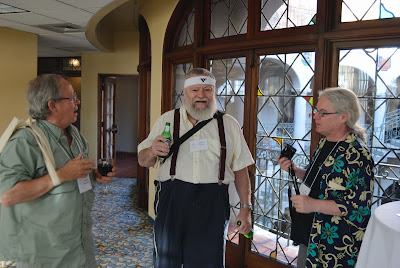
Stevenson, Farris y Carpenter durante la recepción de bienvenida. (foto de GY Zhang)


Quentin Wheeler, en la conferencia plenaria inaugural. (foto de GY Zhang)
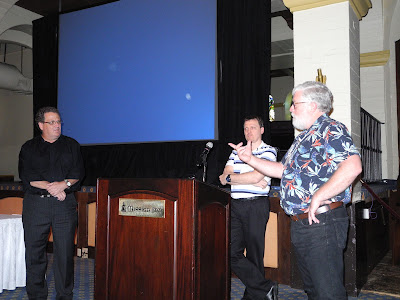
 
Wheeler, Meier y Mishler durante el simposio sobre el concepto de especie. (foto de GY Zhang)

Los premios a estudiantes:
John Denton fue distinguido con el premio Willi Hennig para la mejor presentacion por estudiantes.
Guayang Zhang ganó el premio Don Rosen para el mejor cartel.
Cecilia Waichert recibió el premio Lars Brundin para la mejor segunda presentación oral.

Quieren ver más fotos?  GY Zhang, del equipo organizador local estarár subiendo fotos a Picasa:‎ https://picasaweb.google.com/112984361567457674060/Hennnig2012Riverside
Saludos desde Riverside!

5 de junio de 2012

Salvador Arias ha ganado el premio GBIF

Salvador Arias ha ganado el premio GBIF - jóvenes investigadores- por el desarrollo del programa para estudios biogeográficos  VIP (Vicariance Inference Program).

Salvador  esta actualmente trabajando en el INSUE-Tucumán, haciendo su Doctorado bajo la dirección de Pablo Goloboff y Claudia Szumik.

Acá mando el Link  de la noticia:


http://www.gbif.org/communications/news-and-events/showsingle/article/awards-tar\
get-novel-research-on-species-distributions


y aquí el del programa:

www.zmuc.dk/public/phylogeny/VIP/intro.htm


Un groso! Felicitaciones Salva!

Santiago Catalano

23 de mayo de 2012

Hennig XXXI Workshop: Scripting with TNT, Riverside, CA

Participantes del taller de scripts con TNT

 
Durante las sesiones del taller

Pablo Goloboff y participantes
There has been enough interest expressed for a post-meeting workshop: Scripting in TNT.
The exact location of that, and where you might book accommodations has not been determined yet.
The workshop will run on the 28th, 29th and 30th, June, 2012


Pablo Goloboff (one of the co-authors of the program) and Mark Siddall (who has experience writing scripts) are offering to give a short, 3-day course on scripting for TNT, in connection with the next meeting of the Willi Hennig Society in Riverside, California (June 23-27, 2012).
TNT is a program for phylogenetic analysis under parsimony. Even David Swofford praises it as a good phylogeny program, and it is widely recognized as one of the most powerful programs for phylogenetic analysis. Casual users find it very difficult, because it presents so many options that it is difficult to begin using it. Thus, the program left Matthew Vavrek totally confused, and The Manual caused irreparable damage to the eyes of poor Paulo Nuin (see the Blind Scientist blog).
The powerful scripting language of TNT makes it possible to use the program for an enormous variety of calculations and tests, with a flexibility far beyond any other single program for phylogenetic analysis. See the script for consistency and retention indices as an example of a very simple script, Siddall's script for partition bootstrapping as something easily accomplished with slightly more knowledge and then as well Pol and Escapa's script for iterative PCR or Goloboff's script for testing delayed character correlation as examples of more complex scripts.
This course (see the syllabus below) would be directed to those people who already have some experience with TNT, those who are capable at least of running an entire standard analysis by means of commands (and, ideally, those with some specific problems which need scripts for resolution). The course will start from the simplest ideas and build up from there; no previous scripting or programming knowledge is required (although it doesn't hurt). It will cover the main aspects of the scripting possibilities, with Goloboff and Siddall tutoring exercises directed at solving gradually more complex problems. The last day will be dedicated to people's projects, helping them design (the initial stage, at least) of their own specific projects. People should bring their own laptops (any operating system is OK).

Course syllabus and more information here >>>

Archivo del Blog

Notificación de contenido nuevo

Ingrese su correo electrónico:

Reciba las noticias en su correo electrónico mediante FeedBurner

Reciba las noticias de Filogenetica.org en:

Follow Filogeneticaorg on Twitter
Siguenos en Facebook

-


Seguidores

Comenta en Facebook

Lo más reciente en el blog de Morfometría Geométrica