Contenido más reciente ...

22 de noviembre de 2011

VII Encontro Nacional de Biologia Evolutiva, Portugal


O VII Encontro Nacional de Biologia Evolutiva terá lugar no dia 21 de Dezembro de 2011, no Museu da Ciência da Universidade de Coimbra, e com o apoio do Museu da Ciência e do CIBIO.

No decorrer do VII Encontro será formalmente constituída a Sociedade Portuguesa de Biologia Evolutiva.

Leer más >>> http://www.biologia-evolutiva.net/

The rise of the black box and the fall of the foundations of systematics.

The Autonomous Algorithm

The S&B Blog will be running a series of posts dealing with the rise of the black box and the fall of the foundations of systematics.

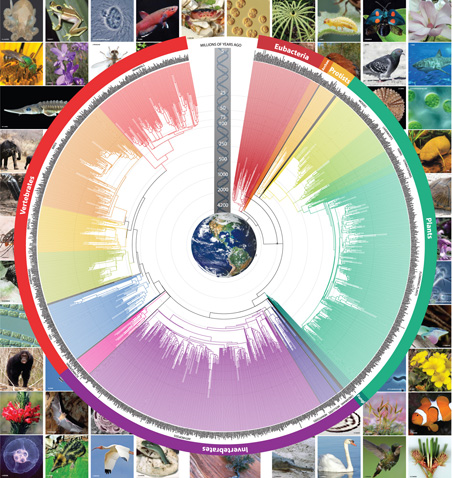
The Timetree of Life: A product
of the Autonomous Algorithm?


Presently, the majority of systematic analyses are constructed in the same way - a matrix is assembled and fed into a computer that then produces a branching diagram. Students of systematics are taught how to produce this branching diagram, using the algorithm, without context to the foundations of systematics. The result is a whole new generation of computer users ignorant of the basic fundamentals of systematics, such as theory (i.e., homology, monophyly), history (i.e., why we do what we do) and methodology (i.e., how to find homologs and construct a cladogram by hand). This also results in an increased dependency on algorithms, which in turn creates a new systematic history and theory that revolves around algorithms rather than concepts. The former black box, which implemented basic algorithms to find approximations of cladograms, is now totally autonomous to the theory, method and history that had gone into its creation. We call this the Autonomous Algorithm.

LEER MÁS >>> http://urhomology.blogspot.com/2011/08/autonomous-algorithm.html

27 de octubre de 2011

No hay crisis, no estamos en extincion, ni somos ermitaños.

Ellos dicen que los taxónomos no estamos en peligro de extinción, ni somos ermitaños antisociales. Segun ellos, no hay crisis en la taxonomia! Esa es la conclusión de un estudio recientemente publicado en TREE:

Lucas N. Joppa, David L. Roberts, Stuart L. Pimm, The population ecology and social behaviour of taxonomists, Trends in Ecology & Evolution, Volume 26, Issue 11, November 2011, Pages 551-553, ISSN 0169-5347, 10.1016/j.tree.2011.07.010.
http://www.sciencedirect.com/science/article/pii/S0169534711002084

Entre varios análisis que presentan, uno me llama la atención: el numero de especies describibles e investigables por taxónomos esta decreciendo! ..... Yo ya aparte mi grupo ..... grrrrrr .... :))

-
Esta es parte de la gráfica 1:

Trends over time in species discovery rates and taxonomic effort. (a) The number of species described per 5 years, (b) the cumulative number of species, (c) the number of taxonomists involved in species descriptions and the (d) species per taxonomists.

Segun esto, el número de especies descritas ha aumentado (A) y el de taxónomos se ha incrementado ..... exponencialmente! (C).

Siendo la referencia de partida los años 1800s, no me resulta sorprendente, ni creo que sea significativo este tipo de incrementos: todo se ha incrementado! No se cuales son los datos, ni de donde vienen, pues los datos no se presentan en el articulo. Pero se esperaría que los datos fueran de algún modo estandarizados, por ejemplo, numero de taxónomos proporcional a la población? Visto asi probablemente el numero de taxónomos no se ha incrementado tanto como otras cosas desde los 1800s!

PD:
Solo como un ejemplo reciente, lean esta nota sobre el estado de la taxonomia en Canada.
Taxonomy in trouble in Canada - November 18, 2010
.... y esta otra nota sobre la Taxonomia en Latinoamerica:
Análisis cienciométrico del estado de la Sistemática en Latinoamerica

Como ven?

Archivo del Blog

Notificación de contenido nuevo

Ingrese su correo electrónico:

Reciba las noticias en su correo electrónico mediante FeedBurner

Reciba las noticias de Filogenetica.org en:

Follow Filogeneticaorg on Twitter
Siguenos en Facebook

-


Seguidores

Comenta en Facebook

Lo más reciente en el blog de Morfometría Geométrica